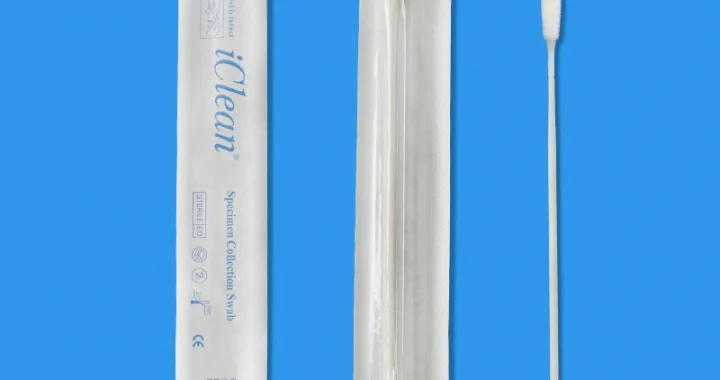
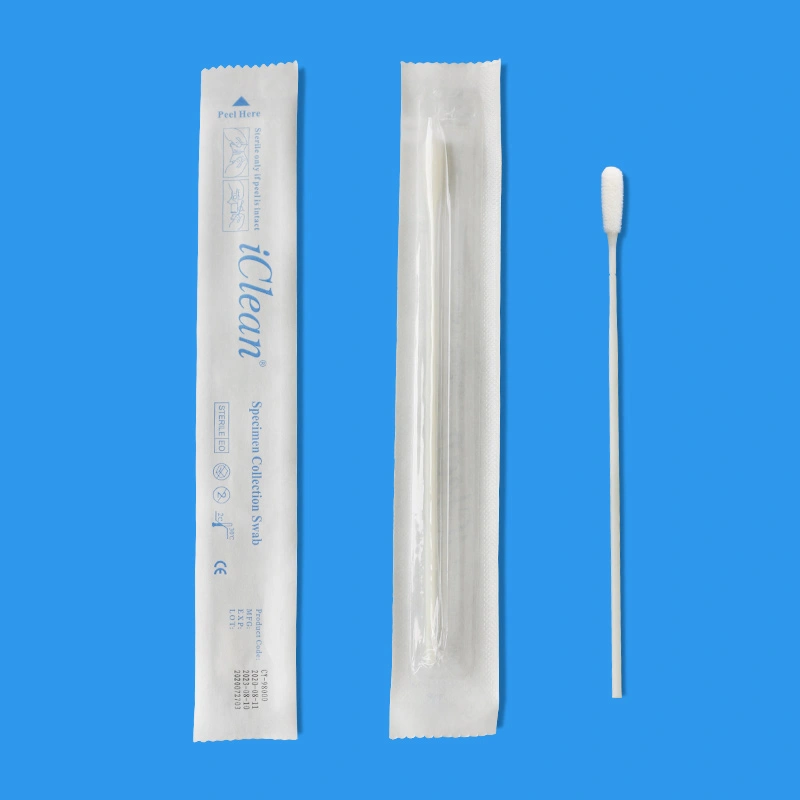
In viral nucleic acid testing, the efficiency of sample collection and release directly determines the lower limit of testing sensitivity. Our high elution rate viral sampling swabs boast an outstanding elution rate of ≥98%, meaning the transfer of samples from swab fibers to preservation solution is nearly complete. Accurate detection is achievable even for trace samples with extremely low viral load, greatly improving the reliability of early detection and screening. Huachenyang provides critical support for high-sensitivity testing with its optimized elution rate data and technological highlights. An elution rate verification report is available for download for your technical review.
Elution Rate Mechanism: Dual Drive of Fiber Structure + Surface Energy
The achievement of high elution rate results from the synergistic effect of micro physical structure and surface chemical properties.
Optimized Fiber Structure: Specially made ultra-fine fibers with a controlled diameter of 20-50 microns are adopted. Compared with traditional fibers, this fine structure significantly increases the specific surface area of fibers (by about 3 times), providing more physical “anchoring points” for capturing viral particles or nucleic acid fragments.
Activated Surface Energy: The fiber surface is modified via low-temperature plasma treatment technology, leading to a significant increase in its surface energy—specifically reflected in a 15° reduction in contact angle. This superhydrophilic surface energy powerfully drives the preservation solution to rapidly infiltrate and “pull out” the samples adsorbed on the fibers during the elution stage.
Comprehensive performance data from Huachenyang’s internal tests shows that the optimally designed swabs, after adsorbing standard samples and undergoing standard elution procedures, achieve a sample release rate (elution rate) of ≥98%, with a 0% inhibition rate of the eluate on subsequent PCR amplification, ensuring the accuracy and efficiency of testing.
Process Revealed: Electrostatic Flocking + Plasma Modification
Behind the excellent performance lies sophisticated manufacturing and modification processes.
Electrostatic Flocking: Nylon short fibers are vertically and evenly implanted into the swab tip in a high-voltage electrostatic field of up to 40 kV, ensuring a fiber upright rate of ≥95% and forming a regular, high-density brush-like sampling surface.
Plasma Modification: After flocking, low-temperature plasma treatment is conducted. This non-invasive process alters the chemical bonds on the fiber surface, resulting in a significant increase in surface free energy by approximately 20 mJ/m², thus achieving long-lasting superhydrophilic properties.
Laser Finishing and Quality Control: Laser technology is used for precise trimming of the flocked area to ensure regular morphology, and fiber shedding is controlled to ≤1 mg, eliminating the introduction of PCR inhibitors caused by lint loss.
Verification Data: Experimental Evidence for Elution Rate ≥98%
The elution rate is not a theoretical value but a reliable figure verified through rigorous experiments.
| Simulated Sample Type |
Standard Adsorption Volume |
Actual Elution Volume |
Average Elution Rate |
Approximate Corresponding Detection Sensitivity |
| SARS-CoV-2 Pseudovirus Particles |
100 μL |
98.3 μL |
98.3% |
10 copies/mL |
| Influenza Virus RNA Fragments |
100 μL |
97.9 μL |
97.9% |
5 copies/mL |
| Bacterial Genomic DNA |
100 μL |
98.1 μL |
98.1% |
10 CFU/mL |
Verification Method: Real-time fluorescent quantitative PCR (qPCR) is used for quantitative detection of target nucleic acid content in the eluate. Each test is repeated n=6 times, with a calculated coefficient of variation (CV) of <2%, indicating stable and reliable data.
Comparison Table: Conventional vs. High Elution Rate Swabs
Compared with traditional swabs, the high elution rate design achieves a leap in multiple key indicators.
| Comparison Item |
Conventional Sampling Swabs |
Huachenyang High Elution Rate Swabs |
| Average Elution Rate |
~80% |
≥98% |
| Sample Residue on Fibers |
~20 μL |
≤2 μL |
| Nucleic Acid Detection Limit (Example) |
~100 copies/mL |
~10 copies/mL |
| PCR Inhibition Rate |
Up to 5% possible |
Essentially 0% |
Core Value: For early infection samples or environmental samples with extremely low viral load, high elution rate technology can capture and release more effective targets, enabling accurate detection of trace samples as low as the 10 copies level, and greatly extending the testing window and improving sensitivity.
Application Scenarios: Triple Coverage for COVID-19/Influenza/Bacteria
With its high elution rate and low inhibition characteristics, this swab is suitable for high-sensitivity detection of various pathogens.
COVID-19 Testing: Used for oropharyngeal and nasal swab sampling to improve the detection capability of samples with low viral load during early infection and recovery periods.
Influenza Virus Surveillance: Also applicable to respiratory samples, helping to distinguish influenza subtypes and monitor viral mutations.
Bacterial Infection Diagnosis: Used for wound swabs, body fluid swabs, etc., to increase the nucleic acid detection rate of fastidious bacteria or low-biomass samples.
Selection and Traceability: Check, Scan, Verify
When selecting high elution rate swabs, attention should be paid to the following key points to ensure performance:
Check Technical Parameters: Focus on the fiber diameter range and third-party elution rate verification data provided by the supplier.
Scan Traceability Information: Choose brands with laser traceability codes on products; scanning the code allows access to production batch, COA (Certificate of Analysis) and other information.
Verify Long-Term Stability: Ask the supplier whether there is a long-term sample retention observation procedure (e.g., 30-month retention) to verify the performance stability of the product within the validity period.
Huachenyang Offers Flexible Options: Models with adjustable fiber density in the 20-50μm range are available according to application needs, with a minimum order quantity (MOQ) as low as 1,000 pieces.
Common Misconceptions and Corrections
Understand high elution rate products correctly and avoid misconceptions.
| Common Misconception |
Potential Problems |
Corrections and Suggestions |
| Assuming a higher elution rate inevitably means a more expensive product |
Risk of missing performance optimization opportunities due to cost considerations |
Many suppliers offer batch tiered pricing with an MOQ as low as 1,000 pieces, delivering high cost performance. |
| Believing denser fiber arrangement (fibers/mm²) is better |
Excessively dense fibers (e.g., >1,500 fibers/mm²) may cause reduced flexibility and increased lint loss, which in turn affects sampling comfort and sample release |
Select products with moderate fiber density (e.g., about 1,000 fibers/mm²) and plasma modification to achieve the optimal balance between adsorption and release. |
| Blindly trusting suppliers’ verbal commitments on elution rate |
Inability to verify actual performance, posing quality risks |
Insist that suppliers provide third-party elution rate verification reports based on quantitative methods such as qPCR. |
Huachenyang High Elution Rate Highlights
Huachenyang demonstrates the following advantages in technical implementation and quality assurance:
Large-Scale Clean Production: Manufactured in a Class 100,000 clean room with an annual production capacity of up to 500 million pieces, ensuring stable supply.
Full-Chain Quality Transparency: Each batch of products is equipped with a laser traceability code; users can download the complete COA report within 30 seconds after scanning the code.
Core Technology Modification: Plasma surface modification technology is adopted to ensure a durable increase in fiber surface energy by about 20 mJ/m², the chemical foundation of high elution rate.
Frequently Asked Questions
Q1: Will the high elution rate characteristic of the swab decrease over time?
Answer: Stable performance. Thanks to the permanent modification of the fiber surface by plasma modification technology, the product can stably maintain an elution rate of ≥98% within the 12-month validity period under specified storage conditions (room temperature, dry).
Q2: Does this swab need autoclaving before use?
Answer: No, and it is not recommended. The product is sterilized by γ-irradiation before leaving the factory, with a sterility assurance level (SAL) of 10⁻⁶, ready to use upon opening. Self-autoclaving may damage the fiber structure or surface properties and affect performance.
Q3: What is the shelf life of the product?
Answer: Under recommended storage conditions, the shelf life of unopened products is generally 36 months. This product is a single-use consumable; after sampling, it should be discarded in accordance with medical waste disposal specifications.
Important Note: This product is a single-use sampling consumable. Please dispose of it as medical waste after use.